Miranda
For Whom the Bell TollsMiranda is a career officer serving the Republic in the Sierra, a defensive commander whose immediate concern is to preserve his position and keep his sector under control. When Andrés reaches his headquarters carrying Robert Jordan’s urgent dispatch for Golz, Miranda verifies the papers and sends him onward; the episode shows both his practical responsiveness and the limits of an army in which orders can be delayed or obstructed at several levels.
Identity and command outlook
Miranda has spent his life in the army and entered the civil war as a lieutenant-colonel. His stated ambition is modest: to finish the war at the same rank. He has defended the Sierra and wants to be left there to defend it whenever it is attacked, rather than pursue advancement or wider command. The narration also presents his private habits and circumstances: he keeps a large supply of sodium bicarbonate, drinks whiskey in the evening, and has a young mistress who is expecting a child. These details make him an individual with a settled routine inside the larger disorder of war, not simply a functionary at a headquarters.
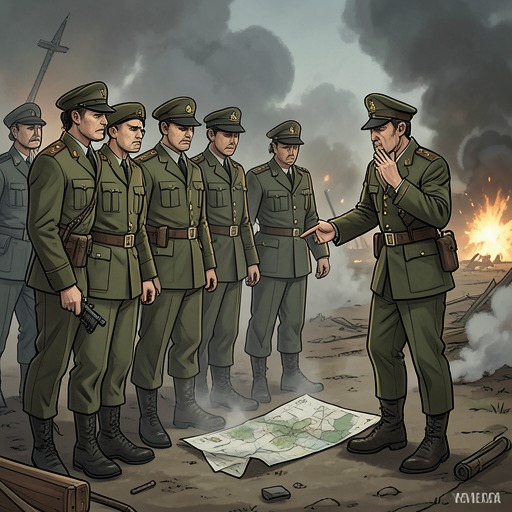
His preference for remaining in the Sierra informs his response to the impending offensive. After dealing with Andrés, Miranda studies the map and considers the offensive possibilities in the country above Navacerrada. He remarks that he is glad Golz, rather than himself, is responsible for the attack. His remark reflects a commander’s awareness of the risks of an operation whose success depends on orders, timing, and resources beyond any one officer’s control.
Andrés’s mission
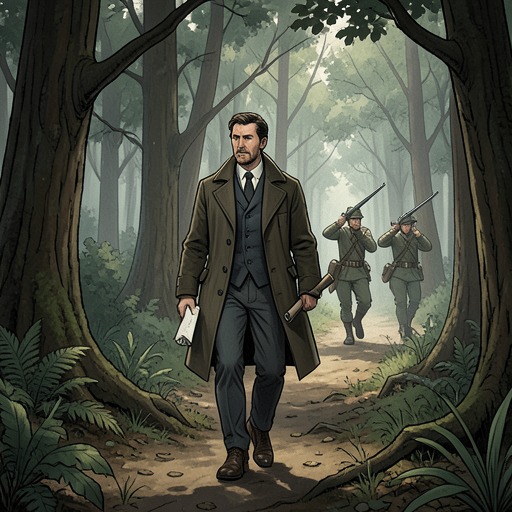
Andrés arrives at Miranda’s headquarters with a safe-conduct and a sealed dispatch from Robert Jordan, intended for Golz. The papers should have moved him rapidly through Republican lines, but the first company commander treats the mission with suspicion, slowing the journey. A battalion commander named Gomez intervenes, takes Andrés onward by motorcycle, and brings him to Miranda’s headquarters.
Miranda examines the safe-conduct, looks at Andrés, and tests the dispatch’s seal before returning both documents. His verification is brief but consequential: rather than detaining the messenger, he accepts the credentials and acts to move the message forward. He asks whether life in the hills is hard and recognizes that Andrés has been with Anselmo. On hearing that Anselmo is well, Miranda says that this pleases him.
Miranda has a typed communication prepared, reads it, and signs it. He instructs Gomez and Andrés to leave quickly, tells Gomez to use the motorcycle’s lights, and advises Andrés to button the papers inside his shirt against the wind. He also sends his compliments to Golz, recalling that they met after Peguerinos. His directions are practical and personal: he treats the dispatch as something to expedite while attending to the conditions of its physical transport.
The larger chain of command
The mission’s urgency is rooted in the timing of the bridge operation. Golz has ordered the bridge destroyed only after the offensive begins, so that reinforcements cannot travel up the road. He is acutely concerned that attacks may be changed, postponed, or interfered with, and that they may not begin on schedule. Robert Jordan therefore needs to warn him that the opposing forces have prepared for the attack. The message’s value depends not just on its contents but on reaching the right commander in time.
Miranda’s authorization does not settle the mission’s fate. Andrés and Gomez encounter further delays, and André Marty later holds them and the dispatch rather than letting them proceed. The narrative observes that the outcome might not have changed even without Marty’s interference: no one at the front had sufficient authority to cancel an attack already set in motion, and a large military operation acquires an inertia that makes it difficult to stop once underway. Miranda can authenticate and forward the papers, but he cannot ensure that the message will reach Golz before the offensive begins.
Narrative significance
Miranda’s brief appearance places considerate, competent conduct inside a cumbersome military system. He takes Andrés seriously, recognizes Anselmo, and gives concrete instructions that help the messenger continue. Yet his administrative action is only one link in a transmission chain vulnerable to suspicion, delay, and competing authority. The contrast between his efficient handling of the papers and the subsequent obstruction underscores the difference between an order being valid and its being effective in time.
His return to the map after the messengers leave completes the scene’s portrait of divided responsibility. He is not directing the bridge demolition or the attack; he studies the possibilities from his own defensive command while Golz bears responsibility for the offensive. Miranda’s preference to remain in the Sierra gives this moment its understated irony: the attack he is relieved not to command is nevertheless connected to his headquarters through the dispatch whose progress he has helped, but cannot guarantee, to accelerate.